
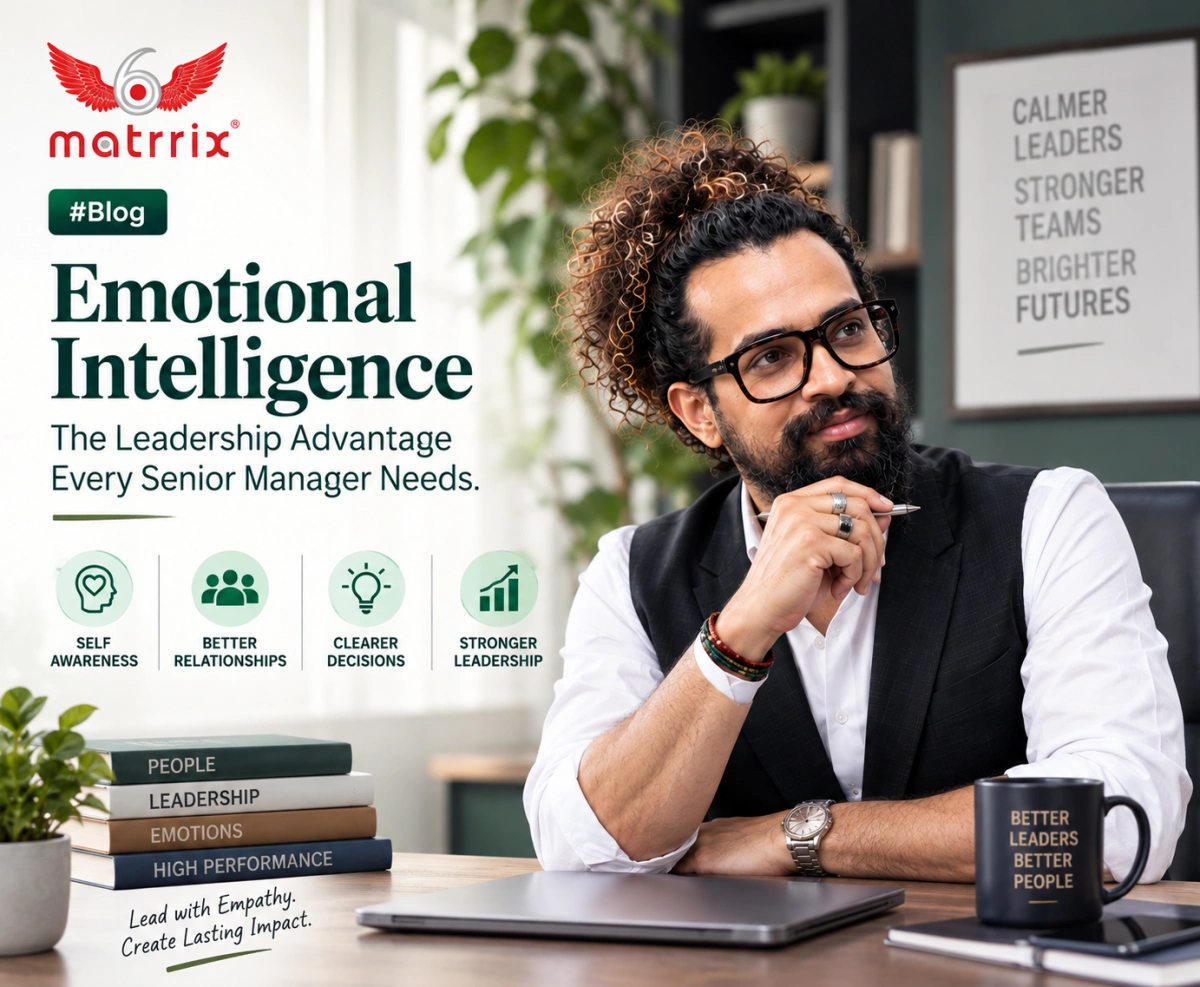
Leadership Success Is No Longer Just About What You Know
After spending 15–20 years building expertise, managing teams, and delivering business outcomes, many senior managers reach a point where technical knowledge alone no longer determines their success.
The questions become different.
- Can you influence stakeholders who do not report to you?
- Can you handle difficult conversations without damaging relationships?
- Can you inspire a team when business pressure is high?
- Can you help your people grow while managing your own expectations and challenges?
These are not questions about intelligence, experience, or technical capability. They are questions about emotional intelligence.
Many senior leaders discover this during important career transitions. They have the experience, the knowledge, and the track record. Yet, the next level of leadership requires something deeper—the ability to understand emotions, build trust, communicate with impact, and create meaningful connections.
Emotional intelligence has become one of the most valuable leadership capabilities for professionals navigating complex business environments.
As organisations become more collaborative and less hierarchical, leaders who can manage emotions effectively often become the ones people trust, follow, and remember.
"Technical expertise may help you reach a leadership position, but emotional intelligence determines the impact you create once you get there." — Dr. Paras |
Understanding Emotional Intelligence in Leadership
Emotional intelligence (EI) is the ability to recognise, understand, and manage your own emotions while also understanding and influencing the emotions of others.
For senior managers, emotional intelligence is not about being overly emotional or avoiding difficult decisions.
It is about making better decisions because you understand the human side of leadership.
Every day, senior leaders deal with situations where emotions influence outcomes:
- A team member resisting organisational change
- A stakeholder disagreement delaying a strategic initiative
- A high performer losing motivation
- A difficult conversation regarding performance
- Pressure from senior leadership during uncertain times
In these moments, emotional intelligence becomes a leadership advantage.
A leader with strong emotional intelligence does not ignore emotions. They use emotional awareness as information.
They ask:
- What is happening beneath the surface?
- What concerns are people not expressing?
- How can I communicate this message more effectively?
- What response will create long-term trust?
This ability separates managers who simply manage tasks from leaders who create transformation.
Meet Dr. Paras: Helping Leaders Transform Through Coaching
At Matrrix, leadership development is built around the belief that every experienced professional has the potential to create a greater impact.
Through executive coaching and leadership development programs, Dr. Paras works with professionals who want to move beyond traditional management approaches and develop stronger leadership presence, communication skills, and coaching capabilities.
With extensive experience in leadership transformation, Dr. Paras helps senior professionals understand their leadership patterns, unlock their potential, and develop the mindset required to lead with greater clarity and confidence.
The focus is not just on becoming a better manager.
It is about becoming a leader who can influence, inspire, and develop others.
"Leadership transformation begins when you stop asking, 'How do I control outcomes?' and start asking, 'How can I create an environment where people perform at their best?'" — Dr. Paras |
Why Emotional Intelligence Matters More as You Become a Senior Leader
Early in your career, your value is often measured by your ability to solve problems.
You are recognised for:
- Your technical skills
- Your execution ability
- Your knowledge
- Your individual contribution
However, as you move into senior leadership roles, your responsibilities change.
Your success depends less on what you personally accomplish and more on how effectively you enable others.
A senior manager is expected to:
- Build high-performing teams
- Influence cross-functional decisions
- Handle conflicting priorities
- Develop future leaders
- Communicate organisational vision
- Maintain confidence during uncertainty
These responsibilities require emotional intelligence.
Consider a leadership meeting where multiple departments disagree on priorities.
Every leader may have strong data and valid opinions.
The leader who creates alignment is not always the person with the strongest argument.
It is often the person who listens carefully, understands different perspectives, manages tension, and guides the team towards a common solution.
That is emotional intelligence in action.
The Five Core Elements of Emotional Intelligence Every Senior Manager Should Develop
According to psychologist Daniel Goleman, emotional intelligence consists of five important areas that influence leadership effectiveness:
1. Self-Awareness: Understanding Your Leadership Impact
Self-awareness is the foundation of emotional intelligence.
It means understanding your emotions, reactions, strengths, weaknesses, and behavioural patterns.
For senior managers, self-awareness helps answer important leadership questions:
- How do people experience my leadership style?
- Do I listen before responding?
- How do I behave when I am under pressure?
- Do my actions match my leadership values?
Many experienced professionals underestimate this area because they believe years of experience automatically create self-awareness.
However, experience only creates growth when leaders take time to reflect.
A leader who understands their own behaviour can make intentional changes instead of repeating old patterns.
For example, a manager may believe they are being "direct and efficient" during meetings, while their team may experience the same behaviour as dismissive.
Self-awareness creates the gap between intention and impact.
"The most powerful leadership shift happens when professionals move from defending their behaviour to understanding its impact on others." — Dr. Paras |
2. Self-Regulation: Responding Instead of Reacting
Senior leaders constantly operate under pressure.
- A critical client escalation.
- A missed business target.
- A challenging employee conversation.
- A sudden organisational change.
In these moments, emotional reactions are natural. However, effective leaders develop the ability to pause before responding.
Self-regulation does not mean ignoring frustration or pretending everything is fine.
- It means managing your response with awareness.
- A leader who reacts immediately may create fear.
- A leader who responds thoughtfully creates trust.
Simple practices that improve self-regulation include:
- Taking a moment before responding to difficult messages
- Separating facts from assumptions
- Asking questions before making judgments
- Recognising personal triggers
These small changes can significantly improve leadership effectiveness.
Take the Next Step Towards Transformational Leadership
Emotional intelligence is not a skill that develops overnight. It is a leadership capability that grows through self-awareness, reflection, practice, and the right guidance.
As a senior manager, you have already built expertise, delivered results, and navigated complex professional challenges. The next stage of your leadership journey is about creating a deeper impact—on your teams, your organisation, and the leaders you help develop.
Through executive coaching and leadership development, you can strengthen your emotional intelligence, enhance your executive presence, improve communication, and build the confidence required to lead in today’s evolving business environment.
At Matrrix, we help experienced professionals unlock their leadership potential through structured coaching journeys designed for real-world leadership challenges.
Whether you want to become a more effective leader, transition from managing teams to coaching leaders, or explore a meaningful second career in executive coaching, the journey begins with understanding where you are today.
Start your leadership transformation journey with Matrrix. Connect with our experts to explore executive coaching opportunities and discover how you can create a greater impact as a leader.
FAQs: Emotional Intelligence for Senior Managers
1. Why is emotional intelligence important for senior managers?
Emotional intelligence helps senior managers understand their own emotions, manage workplace challenges, and build stronger relationships with teams and stakeholders. At senior levels, leadership success depends not only on technical expertise but also on the ability to influence, communicate, and inspire people.
2. Can emotional intelligence improve leadership effectiveness?
Yes. Leaders with strong emotional intelligence are better equipped to handle difficult conversations, resolve conflicts, build trust, and make balanced decisions under pressure. It helps managers create stronger teams and improve overall leadership effectiveness.
3. Is emotional intelligence a natural ability or can it be developed?
While some people may naturally demonstrate emotional awareness, emotional intelligence can be developed through practice, reflection, coaching, and continuous learning. Senior professionals can strengthen their self-awareness, communication skills, and leadership approach at any stage of their career.
4. How does executive coaching help improve emotional intelligence?
Executive coaching helps leaders understand their behavioural patterns, identify leadership gaps, and develop strategies to improve their communication and decision-making abilities. A coach provides structured guidance, reflection, and accountability to support long-term leadership growth.
5. Is emotional intelligence more important than technical skills for leaders?
Technical expertise remains important, but senior leadership requires additional capabilities such as empathy, influence, communication, and relationship management. Emotional intelligence helps leaders apply their knowledge effectively by connecting with people and creating alignment.
6. How long does it take to develop emotional intelligence as a leader?
Developing emotional intelligence is an ongoing leadership journey. Some improvements can be seen through focused practice and coaching within a few months, while deeper behavioural transformation develops through consistent reflection and application.
7. Can senior managers transition into executive coaching?
Yes. Many experienced professionals transition into executive coaching after developing coaching skills, leadership expertise, and recognised credentials such as ICF certification. Their industry experience becomes a valuable asset when helping other leaders grow.
8. What is the difference between managing people and coaching people?
Managing focuses on achieving goals, assigning responsibilities, and ensuring performance. Coaching focuses on helping individuals discover solutions, develop confidence, and unlock their potential. Modern leaders need both skills to build high-performing teams.