
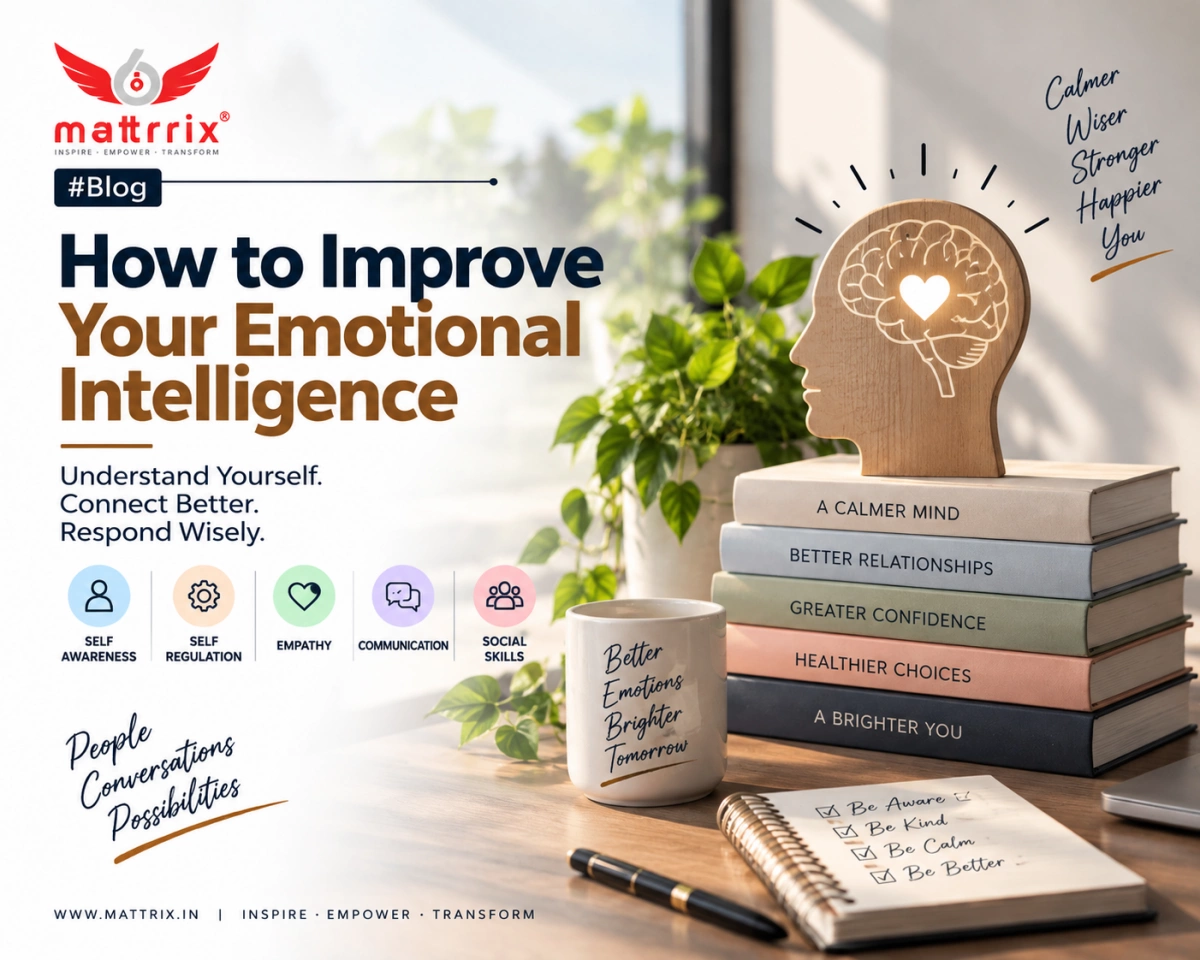
4) Blog Topic: How to Improve Your Emotional Intelligence
How to Improve Your Emotional Intelligence
Have you ever thought after a conversation or a situation thinking, “ I could have dealt with this better.. Or I should have said this…” May you didn't share what you really intended to do, overreacted, misunderstood someone, or struggled to explain yourself. Here is where one needs emotional intelligence.
But here is the good news! You can build emotional habits. You can improve emotional intelligence with small, conscious everyday consistent changes. It will change the way you react to others, the way to connect and communicate.
In this article, you will explore simple and uncomplicated ways to be emotionally intelligent, practical aspects suitable for your everyday life.
What Is Emotional Intelligence (In Simple Terms)?
Daniel Goleman defines Emotional Intelligence (EQ or EI) as the ability to recognize, understand, manage, and use our own emotions and those of others effectively. It is a set of competencies distinguished from fixed IQ that can be learned and improved, comprising five core components: self-awareness, self-regulation, motivation, empathy, and social skills.
It is your ability to understand your own emotions and those of others and the way to respond.
Here is what it includes:
- Being aware of what are you feeling in the here-and-now moment
- Managing your reactions to situations
- Understanding others and their feelings
- Communicating and conveying your thoughts effectively
These are a few emotional intelligence skills that could help you to deal with real-life situations and complex situations and maintain harmony in your everyday relationships with people and yourself.
Why Emotional Intelligence Matters Now?
Clearly, we know the world is struggling at several ends and also advancing at rocket speed with innovations and technical transformations. So as humans, we are upgrading technically by equipping us with skills, but what about our emotional health? People skills? Managing rapid changes that happen around us? The ones who are successful are the ones who can manage emotions along with processes.
And that's why emotional intelligence in the workplace is more important than ever in today's times.
It helps you to:
- Handle everyday work stress and burnout.
- Build relationships that are tangible and meaningful.
- Resolve conflicts in appropriate ways. - Work well along with teams and grow together.
And emotional intelligence in leadership is all the more relevant in today's times, it always has been. Leaders who are emotionally intelligent lead better; the team succeeds in their personal and professional growth and empowers the organizations.
If you are someone who wishes to build emotional intelligence skills, here are the steps for you:
Step 1: Begin With Self-Awareness
The first step to improve emotional intelligence is to go inwards, notice what you are feeling, how you feel an emotion. It is something that is unique to you. Most of us are not aware of ourselves or our emotions and often function on the go as if driven by a motor. We may react abruptly, feel triggered for no reason (there is a reason, but we often are not aware). Begin with asking:
- Why am I feeling this way?
- What am I feeling right now?
Can You Try This Simple Habit:
In a day, simply pause and name an emotion you are feeling at that moment.
- Name “I’m feeling stressed."
- Name “I’m feeling ignored."
- Name “I’m feeling excited."
Naming emotions is the first step to building healthy emotional intelligence skills.
Step 2: Practice: Pause Before Reacting
Think of a situation where you reacted strongly and regretted it later. That could be a sign of low emotional control and not poor intelligence.
In order to improve emotional intelligence, you need to create a space between feeling and reacting.
Here is a Simple Trick:
When intense emotions arise, pause for 5 seconds. That pause can stop unnecessary arguments, help you think clearly, and improve your emotional intelligence and communication. This can also help have emotional intelligence in workplace where quick reactions can affect relationships.
Step 3: Begin To Understand Others Differently
Empathy is a popular word but also difficult to practise when you are not in a happy space or in an argument or dealing with a misunderstanding.
Empathy is one of the most important emotional intelligence skills. It is your ability to understand what someone else is feeling even if you don't agree with it
Begin with empathy to improve emotional intelligence.
Here Is How You Can Practice Empathy:
- Try to listen without interrupting or asking a question or filling the gap
- Try to shift the perspective, see it from different lens
- Maybe ask, “What might they be going through?”
The key part of emotional intelligence in leadership is empathy, because if a leader understands, the people in it will too!
Step 4: Improve Your Communication
Communication is not just talking; it is also about understanding and sharing your thoughts well.
Emotional intelligence and communication are interlinked.
Here are some tips for better communication:
- Even when you are upset try to use less words and Speak calmly
- Avoid language that has ‘You always…’
- Use statements that begin with "I" or "We."
- Pay attention to your tone and verbal and nonverbal language
To improve emotional intelligence, you can begin with communication too, in fact, self-awareness, empathy, and communicating all these emotional intelligence skills can be practiced every day.
Step 5: Handle To Not Take Criticism Personally
Criticism is a part of growing, but managing it can be tricky and mostly it hurts. But emotionally intelligent people try to separate feedback from personal attack. Then take the relevant points, make notes, and move on. They don't really dwell in it for long, taking it personally, trying to resolve it, and then staying in it for so long that it hampers growth. They simply move on fast, as they know it's not on them.
This mindset is important to improve emotional intelligence. Here is what you can do:
- Know that not all criticism is bad
- Some feedback may really help you grow and know what to take back home
- Pause, try not to react immediately, process, and respond calmly. This may sound ideal, but it is the best action response.
This skill is a bonus skill, especially when you practice emotional intelligence in the workplace. It makes you less defensive and more responsive.
Step 6: Manage Stress in Better Ways
Stress affects you, we all know. It makes you restless, unhappy, and worried and often is an energy sucker. It is not always possible to be EQ smart, but yes, you can begin with being mindful, being self-aware, and finding your tool as shared above. In emotional intelligence training, managing stress is the core part.
Here is how you can practice:
Take short breaks during work
- Go for a walk if you can; 10 minutes everyday can help too.
- Take short work breaks, may not be coffee or tea, simple quiet breaks
- Practice deep breathing, mindfulness
- Talk to someone you feel comfortable with; sharing helps
These habits help you stay calm and improve emotional intelligence over time.
Step 7: Reflect on Your Day
One of the easiest ways to develop emotional intelligence is reflection.
At the end of your day, ask:
- What went well today?
- Where did I overreact?
- What could I do differently next time?
These emotional intelligence skills and healthy practices help you manage stress better. It is a mix of skills and healthy habits that makes you grow.
Step 8: Learn When & How to Say No
Many people struggle to say no and manage boundaries and end up feeling heavy and burdened. They often end up saying a "yes" when they really can't deliver, which leads them to frustration and conflicts.
To improve emotional intelligence, you need to respect your boundaries and first build them too.
Practice This:
- Say no clearly and firmly
- Do not overexplain over why you cannot
- Respect your time, be firm, say no wherever you are supposed to
Saying no is important when you practise emotional intelligence in workplace
Step 9: Be Open to Learning
Nobody is perfect. Not even our emotions, we learn along the way, discover new facets of ourselves. It is continuous progress.
That’s why emotional intelligence training can be life-changing. It gives you tools to express and internalize your emotions.
You can begin with:
- Books, and reading blogs like this
- Participate in the Workshops
- Attend Online courses
- Learn through Real-life experiences
The more you practice, the more it will improve emotional intelligence.
Step 10: Practice Active Listening
We often listen to respond and not to understand; active listening is an important part of emotional intelligence and communication.
Here is How You Can Listen Better:
- Maintain eye contact, when you are talking to someone, always
- Don’t interrupt, fill in the gaps, add extra words or questions in the middle
- Paraphrase, or repeat what the other person said, a recap to ensure no details are missed.
This helps to build a strong presence and important emotional intelligence skills to practice.
Using Emotional Intelligence in Leadership
Let us talk about emotions in leadership. Great leaders are emotionally aware and know when and how to express them (most of the time).
Using emotional intelligence in leadership and the workplace enables them to:
- Encourage and Motivate teams
- Resolve conflicts well
- Build strong relationships with teams
- Create a positive and cohesive surrounding
If you are into leadership roles or wish to be one, learning how to develop emotional intelligence is the best skill to develop.
Using Emotional Intelligence at Work.
Workplaces can be challenging and stressful. Hence, the need for emotional intelligence in the workplace makes it all the very more important.
It helps you to:
- Stay calm even under pressure and tricky situations
- Communicate clearly and firmly to avoid misunderstandings
- Avoid conflicts
- Build a positive environment
When you improve emotional intelligence, you become easier to work with and more productive, so you know what to pay attention to and what to ignore, and also people begin to trust you and your company.
A Few Common Mistakes to Avoid In EI
While you are trying to improve emotional intelligence, here is what not to do:
- Ignoring your emotions instead of addressing them. Do not suppress. Find the root cause and seek help.
- Reacting without thinking instead of responding
- Assuming that you know what others are feeling
- Avoiding difficult conversations with yourself and with others.
Here Is A Simple Daily Routine to Build Emotional Intelligence
If you are wondering how to develop emotional intelligence in everyday lives, you can follow a daily routine as follows:
Morning Time
- Try to set an intention for the day. It could be a small doable goal. (e.g., “I will stay calm today by not reacting but pausing and reponding”)
During the daytime
- Pause (5-6 seconds) before reacting
- Practice listening without interrupting
Evening Time
- Reflect and observe your actions
- Note them and continue building healthy habits
Activities such as this and some more are included in the emotional intelligence training, which helps to build habits and notice changes over the period of time.
To improve emotional intelligence, you need practice and readiness to build those skills. It makes you more aware; you begin to observe yourself and manage emotions effectively.
Knowing how to improve emotional intelligence is not about perfecting it. It is about being more aware of how you respond to certain emotions, how you feel them, and how you can use them effectively.
Always start small."
- Begin to Notice your feelings (what makes you angry, sad or nervous)
- Try to Pause before reacting or giving a reaction
- Try to Listen more without interrupting
- Reflect on your efforts daily
With practice, you will build powerful habits.
Personally and professionally, with practice you will understand yourself and others better. Emotional intelligence is a skill that truly changes everything.
So, begin today. You will find improved emotional intelligence with practice. At Matrrix we work with people to do so with systematic coaching methods.
…
Personal Note by Dr. Paras
We all know everything takes time. A skill or even a habit. Also, we forget that readiness also matters. As a coach, I may give a plan, a convincing one, but what I feel works best when both parties are committed to it. EQ comes with practice and the skills are not something that you apply in specific situations, they are universal for all kinds of settings, whether it is with people or for yourself.
If you wish to begin, start by naming your emotions. It is not as easy as it sounds. For example, if you are feeling angry, name it and notice what happens. I encourage this practice, because once you start naming them, for yourself, you do not really react immediately, you take a back step and observe what is happening with you. In order to name them, you can move from that place, take a break and sense it. If you have a powerful self-talk, it shall help you to analyse what is happening and how you are feeling.
In overwhelming situations, take frequent breaks whenever you can. You will have to find time to calm yourself down, notice the chaos and then get back to it at full throttle. WHever a lot of chaos happens, sit back and notice what everything and everyone is saying or feeling, you will know it is not about you, rather it is their reactions to something to a common situation.
Listening is the next level where it is difficult to master where we are living in a world everywhere everyday and everyone has an opinion about something. Try to resist reacting while people are talking to you. It is a practice I encourage a lot of coaches too in my school. It is rather the first step in building emotional intelligence, because as you listen to others you begin to internalise your own thoughts and you become mindful of what others say. Empathy builds with listening.
The hardest part? Managing your triggers. Honestly, you can perfect the process as emotions and feelings can often surprise you. When you experience something, you cannot predict how you will feel about it. Pausing helps. That is the reason when people fail, they are not sure how to deal with it. Surprising reactions are mind work.
What not to do during such times is talk to something, state it in words, name them and seek help. It may be for a few moments, but talking out helps. I have been there and done that. Self-inquiry helps in such situations, you can begin to observe yourself and question the root cause and effect and then find solutions with someone or by yourself. But do it, it is not only you, it happens to each one of us all the time.
Emotional Intelligence is not automatic, although a few basic emotions within us are innate. The way to manage them needs to be worked out, and there is no secret formula. It is also true that sometimes it feels exhausting to be emotionally stable and yet experience friction with people. Choose your company wisely, know when you leave, or move out of a relationship.
.
Growth happens with readiness, being aware, and with effort. That's all. Why emotions matter? Because you are a unique set, and it is time to unlock it and use it as a tool.
Dr. Paras Daithankar has a PhD in Organizational Behavior, MCC-ICF, Winner - ICF Young Leader Award 2018, and is the founder of Matrrix, Pune, India. He firmly believes in using the power of coaching to revolutionize change. He founded Matrrix, bringing world-class and affordable ICF Coaching certification globally. With the ICF Programs, Life Coach Certification, Executive Coaching, he trains and mentors individuals and teams through structure and standardization. His approach is a unique blend of psychology, philosophy, spirituality, and leadership. Also combining principles as a Mindfulness Practitioner© ® ️ known as ‘Temple Man,' who loves to explore places that draw inspiration through ancient temples and worshipping places along with being an exclusive NLP Richard Bandler Certified Alumni. His coaching is based on his three core principles of 'Inspire Self , Empower Others, Transform Generations'.